
Pooper Scooper Insurance: Coverage, Costs, What You Need
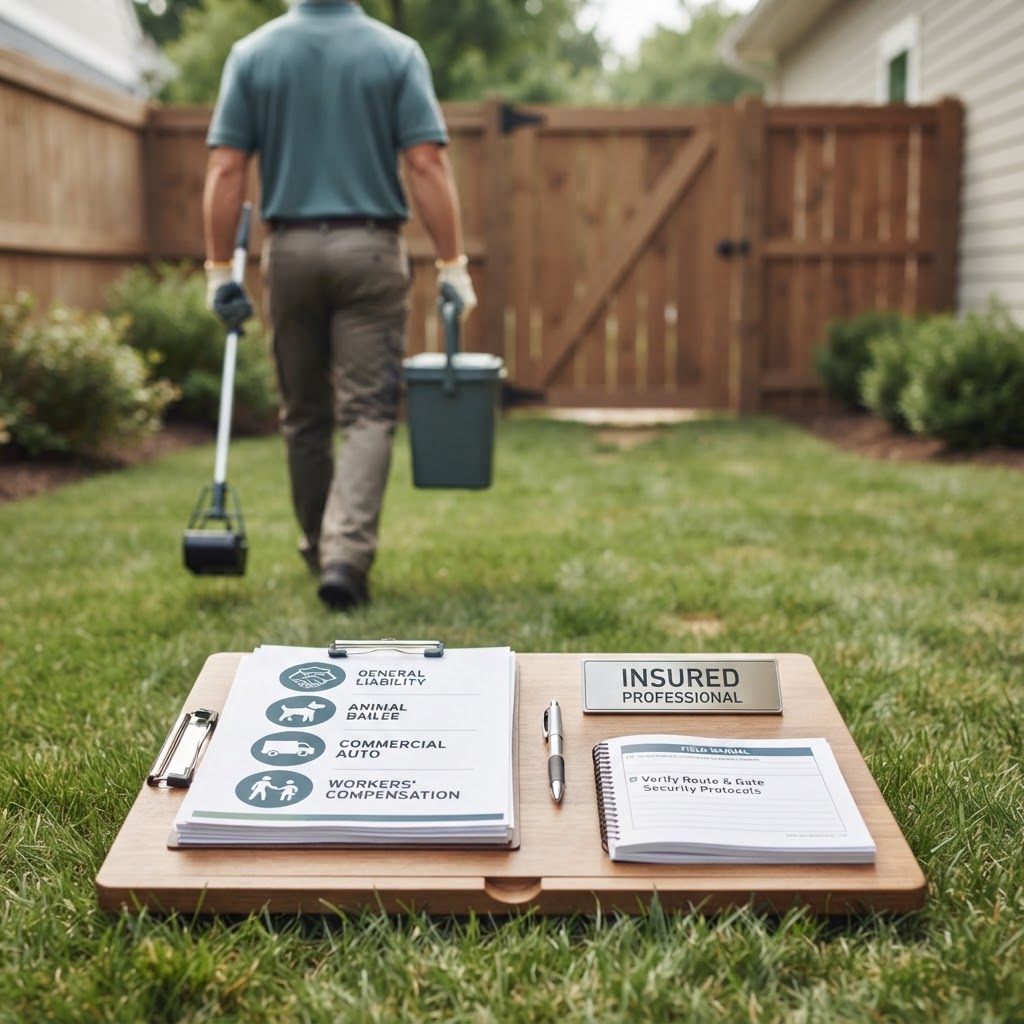
title: "Pooper Scooper Insurance: Coverage, Costs, What You Need" h1: "Pooper Scooper Insurance: What Coverage You Need and What It Costs" slug: "pooper-scooper-insurance" meta_description: "Pooper scooper insurance explained: general liability, animal bailee, commercial auto, workers' comp, bonding, and published starting prices from insurers." excerpt: "What general liability, animal bailee, commercial auto, workers' comp and bonding cover for a pet waste removal business, with published starting prices." category: "Legal, Insurance & Admin" target_query: "pooper scooper insurance" author: "ScooPilot Team" featured_image: "pooper-scooper-insurance.png" featured_image_alt: "Pet waste removal technician closing a backyard gate with a dog inside the fence" image_headline: "Insurance Every Pooper Scooper Business Needs" reading_time_min: 9 status: draft
Most pooper scooper businesses need general liability insurance with animal bailee (care, custody, and control) coverage, plus commercial auto if you drive to jobs and workers' comp once you hire. Specialty pet business insurers publish starting prices around $194 to $220 a year for a basic scooper policy, though your actual quote depends on your state, size, and claims history. Add-ons like equipment coverage and bonding cost extra.
This is general information, not legal or insurance advice. Confirm what you need with a licensed agent and your state.
Do you really need insurance to scoop poop?
Whether a policy is legally required depends on your state and local business licensing rules, so check those first. Either way, you walk into strangers' yards every week, open their gates, and work around their dogs. That is where the risk sits.
Two incidents cause most of the worry: a gate left unlatched so a dog gets out, or damage to something on the property like a fence panel or sprinkler head.
Insurance also helps you sell. Some customers ask before they sign up, and commercial accounts often want a certificate first.
What general liability covers for a scooping business
Pet Care Insurance describes its scooper general liability as covering "physical injury and property damage to others," with limits of $1 million per incident and $2 million per year (Pet Care Insurance). Insurance Canopy lists the same $1M/$2M limits and gives scooper examples: accidentally damaging "a client's lawn, fence, or property during cleanup," or someone tripping over your equipment (Insurance Canopy).
What general liability may not cover is the dog itself. Pet Sitters Associates states its policy has "a special exclusion for property in your care, custody, and control," and it lists pet coverage separately (Pet Sitters Associates).
Animal bailee coverage: when the dog is the claim
Animal bailee coverage (sometimes called care, custody, and control) pays when an animal in your care is hurt, lost, or killed. For scoopers, the classic case is a dog getting out of the yard during your visit.
Pet Care Insurance uses that exact example: "Gate failed to latch, allowing a client's dog to escape, $5,000 covered." Its animal bailee limits are $2,500 per incident and $5,000 per year, with separate vet reimbursement of $1,000 per incident and $2,500 per year after a $250 deductible (Pet Care Insurance). Insurance Canopy lists the same bailee limits plus animal liability of $100,000 per incident (Insurance Canopy). Pet Sitters Associates lists $15,000 per occurrence and $30,000 per year for pets "lost, stolen, injured, or killed in your care" (Pet Sitters Associates).
Look hard at those limits. A dog hit by a car after escaping could run up vet bills far past $2,500. When you compare quotes, check the bailee limit as closely as the headline $1 million liability number.
Commercial auto: your personal policy may not cover the route
If you drive to jobs, check your auto policy before anything else. GEICO says "most personal auto policies exclude business-related driving," and lists transporting equipment as an example of work use (GEICO).
A scooper drives a route daily and hauls tools and waste. That looks like business use. Ask your auto insurer whether your route is covered, what a business-use option costs, and get the answer in writing.
Commercial auto is not cheap. Insureon reports a median of $245 a month for small businesses that buy commercial auto through it, including pet care companies (Insureon).
Workers' comp once you hire
Workers' comp covers employee work injuries, and each state sets its own rules. The U.S. Department of Labor directs private-sector workers injured on the job to "contact their state workers' compensation board" (U.S. Department of Labor).
Thresholds vary a lot:
- Virginia requires coverage for an employer "who regularly employs more than two part-time or full-time employees" (Virginia Workers' Compensation Commission).
- North Carolina requires it at three or more employees, according to one insurance agency's 2026 summary, which also lists other Southeast states at four or five (Bridgeway Insurance).
Check your state's workers' comp agency before your first hire, even a part-timer.
Insureon reports a median of $97 a month for pet care companies that buy workers' comp through it (Insureon).
If you are planning to grow a crew, our guide to starting a pooper scooper business covers when hiring starts to make sense.
Bonding and employee dishonesty coverage
A bond (or employee dishonesty coverage) protects customers against theft by you or your staff. Scoopers rarely go inside homes, but you may hold gate codes or keys.
- Pet Care Insurance offers employee dishonesty coverage as a bonding alternative at $4.92 a month, with $10,000 per occurrence and $25,000 aggregate (Pet Care Insurance).
- Pet Sitters Associates sells a "Broadened Property Damage Coverage & Bond" add-on for $115, with $10,000 per occurrence and $25,000 per year (Pet Sitters Associates).
- Business Insurers of the Carolinas offers bonding but does not publish prices online (Business Insurers of the Carolinas).
Pet Care Insurance also includes lost key liability up to $2,000, which matters if a customer gives you a key to a locked gate.
Tools and equipment coverage
General liability is for harm to others. If your scoopers and bins get stolen from your truck, that takes separate equipment coverage.
Pet Care Insurance and Insurance Canopy both list equipment coverage starting at $4.08 a month (Pet Care Insurance, Insurance Canopy). Our pooper scooper equipment list can help you total up what you would need to replace.
Pooper scooper insurance coverage and cost table
Prices below are published starting prices pulled from insurer websites in October 2026. They change often and depend on your state, payroll, and claims history. Treat them as a starting point, not a quote.
| Coverage type | What it covers | Who needs it | Published starting price |
|---|---|---|---|
| General liability (with animal bailee) | Injury or property damage to others; pets hurt or lost in your care, up to the bailee limit | Every scooper | $194/year or $17.98/month (Pet Care Insurance; same listed by Insurance Canopy). $220/year membership (Pet Sitters Associates) |
| Animal bailee / care, custody, control | Dog injured, lost, or killed during your visit | Anyone who works with dogs in the yard | Included in the policies above, check limits |
| Commercial auto | Accidents while driving for work | Anyone driving a route | Custom quote (Insurance Canopy). Median $245/month for small businesses (Insureon) |
| Workers' comp | Employee injuries and lost wages | Required once you pass your state's employee threshold | Custom quote. Median $97/month for pet care companies (Insureon) |
| Bond / employee dishonesty | Theft from customers by you or staff | Optional, more useful with keys, codes, or a crew | $4.92/month (Pet Care Insurance). $115 add-on (Pet Sitters Associates) |
| Equipment / tools | Theft or damage to your own gear | Optional, more useful as gear value grows | $4.08/month (Pet Care Insurance) |
Factor insurance into your rates. If you have not set prices yet, our pet waste removal pricing guide walks through building your costs into what you charge.
Do customers and HOAs ask for a certificate of insurance?
Yes, especially commercial accounts. A certificate of insurance (COI) is a one-page summary of your coverage. Hiscox describes it as "a one pager that provides policy details on your liability insurance coverage," showing the insurer, policy number, limits, and dates (Hiscox).
HOAs, apartment complexes, and property managers commonly ask for one before you service common areas. Some residential customers ask too, though fewer. A client may ask to be listed as a certificate holder. Hiscox notes that the certificate "simply establishes that an insurance policy exists" and does not give the holder rights under your policy. If a contract asks you to name them as an additional insured, that is a different request. Ask your insurer whether it is available and what it costs.
Keep a current PDF of your COI on your phone so you can send it the same day.
How to read a policy exclusion
The exclusions section tells you what the policy will not pay for. Read it before you buy, not after a claim.
Exclusions that matter for scoopers, from published examples:
- Aggressive dogs. Pet Care Insurance excludes "dogs with a history of aggression," and says this applies to individual dogs, not breeds (Pet Care Insurance exclusions). If a customer's dog has bitten before, ask how that affects coverage.
- Landscaping. Pet Care Insurance excludes landscaping services (Pet Care Insurance exclusions). If you add deodorizing treatments, mulch, or yard work, confirm those services are covered.
- Your own injuries. Pet Care Insurance notes that your own injuries are not covered and need personal health insurance (Pet Care Insurance).
- Off-leash deductibles. Pet Sitters Associates applies a $500 deductible when a client's pet is voluntarily released from its leash outside the fenced yard (Pet Sitters Associates).
A simple way to read any exclusion: picture your most likely bad day (a dog gets out, a fence breaks, an employee hurts their back) and search the policy for each one. If you cannot find clear coverage, ask the agent to point to the wording.
Questions to ask an insurance agent
Bring this checklist to every quote:
- Is pet waste removal listed as a covered operation by name?
- What are the animal bailee limits per incident and per year?
- Does my personal auto policy cover driving my route, or do I need commercial auto?
- Are deodorizer or yard treatment services covered, or excluded as landscaping?
- How do dogs with a bite history affect my coverage?
- At what number of employees does my state require workers' comp, and do part-timers count?
- Are independent contractors covered, and what does that cost?
- How fast can I get a certificate of insurance, and can I add additional insureds?
- What is the deductible on each coverage?
- Is the policy per-occurrence or claims-made?
How ScooPilot handles this
Insurance pays after something goes wrong. Good records help you show what happened, and good field information helps keep it from happening.
ScooPilot's field tech app runs in the phone browser. Each stop shows the gate code, dog notes, and special instructions for that property, so a tech who has never been to the yard sees "back gate sticks, push until it clicks" before opening it. That reduces the risk of a gate-left-open incident. It does not eliminate it.
Techs take proof-of-service photos and add field notes from the app, and each visit is recorded when they tap start and complete. If a customer later says the gate was open or a planter was broken, you have a dated record of the visit, photos, and notes to check. That helps when you sort out a dispute or report a claim to your insurer. It is your own documentation, not something insurers require or discount for.
Offline mode lets techs keep working in spots with weak signal and sync later. Two-way SMS keeps the conversation with the customer in one place if an incident needs follow-up. You can see the full list on the Features page.
Plans start at $10/month with a 14-day free trial.
FAQ
How much does pooper scooper insurance cost?
Specialty insurers publish starting prices around $194 a year (Pet Care Insurance and Insurance Canopy) to $220 a year (Pet Sitters Associates) for a basic scooper policy. Add-ons like equipment, bonding, commercial auto, and workers' comp cost extra. Prices change and depend on your state and business, so get current quotes.
Does general liability cover a dog that escapes during my visit?
Usually not by itself. Many general liability policies exclude property in your care, custody, or control. You need animal bailee or care, custody, and control coverage, which pet-specific scooper policies often include. Check the per-incident limit.
Do I need commercial auto insurance for a pooper scooper business?
Possibly. GEICO says most personal auto policies exclude business-related driving. Ask your auto insurer whether driving a daily service route is covered, and get the answer in writing.
Do I need workers' comp as a solo pooper scooper?
Usually not while you are the only person working, but it depends on your state and business structure. Requirements kick in at different employee counts by state; Virginia's rule is more than two employees, part-time included. Check your state agency before you hire.
Do I need to be bonded to start a pooper scooper business?
Bonding is usually optional for scoopers since you rarely enter homes. It is more useful when you hold keys or codes or run a crew. Published add-ons start around $4.92 a month or $115 a year.
Sources
- Pet Care Insurance: Pooper Scooper Insurance
- Pet Care Insurance: Exclusions
- Insurance Canopy: Pooper Scooper Insurance
- Pet Sitters Associates: Pet Business Insurance Options
- Business Insurers of the Carolinas: Pet Sitter, Dog Walker, Pet Taxi and Pooper Scooper Insurance
- Insureon: Pet Care Business Insurance Costs
- GEICO: Does Commercial Auto Insurance Cover Personal Use?
- Hiscox: Certificate of Insurance
- U.S. Department of Labor: Workers' Compensation
- Virginia Workers' Compensation Commission: Insurance Information for Employers
- Bridgeway Insurance: Workers' Compensation Requirements in North Carolina
Ready to see it in action?
Explore how ScooPilot connects customer management, scheduling, routing, and billing for pet waste businesses.
Try the ScooPilot live demo