
How to Start a Pooper Scooper Business in 10 Steps
title: "How to Start a Pooper Scooper Business in 10 Steps" h1: "How to Start a Pooper Scooper Business: A 10-Step Plan" slug: "how-to-start-a-pooper-scooper-business" meta_description: "How to start a pooper scooper business: pick a tight service area, set up an LLC and EIN, get insured, price by dogs and frequency, and land first customers." excerpt: "A step-by-step plan for starting a pooper scooper business, from choosing a tight service area to pricing, autopay, first customers, and winter. Every number is sourced." category: "Start a Scooping Business" target_query: "how to start a pooper scooper business" author: "ScooPilot Team" featured_image: "how-to-start-a-pooper-scooper-business.png" featured_image_alt: "Pooper scooper business owner with a rake and bucket walking into a fenced backyard" image_headline: "Start a Pooper Scooper Business Right" reading_time_min: 13 status: draft
To start a pooper scooper business, pick a small service area with lots of dog-owning households, register the business (LLC or sole proprietorship, plus a free EIN), get general liability insurance, buy a basic tool kit, and set recurring weekly prices based on number of dogs, yard size, and frequency. Then put every customer on autopay and fill one tight route before you expand. Published guides put a bare-bones start at a few hundred dollars, but the businesses that last are the ones that get route density and recurring billing right from day one.
Below are the 10 steps in the order you will actually do them, with sourced cost and pricing numbers.
Step 1: Check demand and pick a tight service area
Demand is not the problem in most of the US. According to the AVMA's 2025 Pet Ownership and Demographic Sourcebook, 42.6% of US households own dogs. That is about 56.3 million households and 87.3 million dogs, or roughly 1.6 dogs per dog-owning home.
So the real question is not "are there dogs here?" It is "can I get enough paying yards close together?"
Why route density beats a big map
Your income comes from time in yards, not time in the truck. Every minute you drive between stops is a minute you are not paid for.
Here is a simple example. Say a weekly yard takes you 12 minutes. If the next customer is 3 minutes away, you can do about 4 yards an hour. If the next customer is 15 minutes away, you are down to about 2. Same price per yard, half the hourly pay. Routific's guide makes the same point: good routing gets you 3 to 4+ yards per hour versus 1 to 2 with poor planning.
How to draw your first service area
ScoopStart's startup guide suggests a total service area you can cross in about 45 minutes or less, with each daily route tight enough to cross in about 15 minutes. That is a reasonable starting rule.
When you pick the area, look for:
- Single-family neighborhoods with fenced backyards. Fences mean dogs stay out back and owners do not walk them as much, so more waste builds up in the yard.
- Two-income households and busy families. These are people who will pay to get an hour of their weekend back.
- Neighborhoods close to where you live. Your first and last drive of the day are unpaid too.
Start smaller than feels comfortable. It is easy to expand a full route. It is hard to fix a route where your 15 customers are spread across three towns.
Step 2: Decide residential vs. commercial to start
Most new scoopers should start residential. The sales cycle is short (a homeowner can say yes the same day), you can start with one yard, and recurring weekly service builds income fast.
Commercial work means apartment complexes, HOA common areas, and pet waste stations. It can pay well, but expect slower decisions by property managers or boards, a certificate of insurance before you start, competing bids, and station restocking on top of scooping.
A good middle path: build residential density first, then add commercial accounts that sit on or near your existing routes. Erica Krupin, who runs Kroopin's Poopin Scoopin, told Jobber she aims for a mix of about 70% residential and 30% commercial. That is a target for an established business, not a starting point.
Step 3: Set up the business
This part takes a few days, not weeks. Do it before you take your first paying customer.
Pick a name
Choose something easy to say on the phone and spell in a search. Check it with your state business registry and make sure a matching domain is open.
Choose LLC or sole proprietorship
A sole proprietorship is the simplest. In many states you just start working under your own name or file a "doing business as" (DBA) name.
An LLC costs more to form and maintain, but ScoopStart notes that many operators choose one because it creates separation between the business and the owner. That separation only holds up if you keep business money separate and run it like a real business. Filing fees and annual fees vary by state.
Get an EIN
An Employer Identification Number is your business's tax ID. You will want one for a business bank account, and you will need one if you hire. You can apply directly with the IRS online, and the IRS states plainly that you never have to pay a fee for an EIN. Skip the websites that charge for it.
Check local licenses
There is usually no special "pooper scooper license." But as ScoopStart points out, you may still need a general business license or permission to operate a service business from your city, county, or state. Call your city business office or county clerk and ask directly. Some counties also have home business rules if you store equipment at your house.
Open a business bank account
Keep business income and spending in a separate account from day one. It makes taxes easier and shows you whether the business actually makes money. Connect your card processor to this account.
This is general information, not legal or tax advice. Rules vary by state and locality, so confirm with your state, your county, or a local accountant or attorney.
Step 4: Get insured
Do not scoop a single paid yard without general liability insurance. You are working on other people's property, opening their gates, and handling around their dogs. A gate left open and a dog that gets out is the kind of mistake you want covered before it happens.
UpFlip's guide reports business insurance costs of about $500 to $2,500, but your actual premium depends on your state, coverage limits, and whether you have employees or a work vehicle. Also ask your auto insurer whether your personal policy covers driving between customer stops, and get the answer in writing.
We cover what policies to get and what to ask your agent in pooper scooper insurance: what you need and what it costs.
Step 5: Buy your equipment
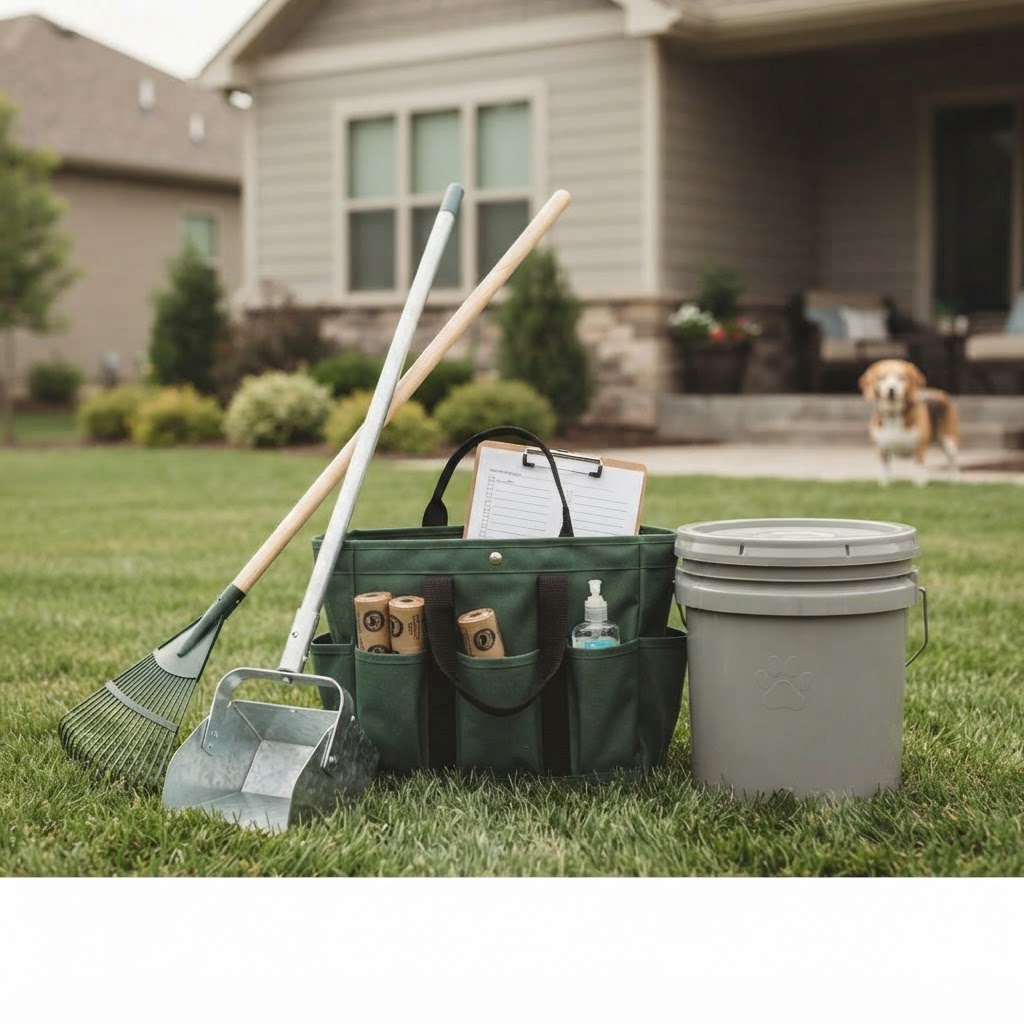
You need less than you think. A basic kit is a rake-style scooper or cultivator, a dustpan or pan scooper, a bucket or bin, bags, gloves, and a sprayer with disinfectant for your boots and tools between yards. That last part matters. Cleaning between yards protects customers' dogs and protects your reputation.
Reported costs for tools are low. Jobber quotes Erica Krupin as saying you can get started for under $200 with gloves, a bucket, trash bags, and a rake, or about $1,000 for a better tool setup. UpFlip reports $100 to $1,000 for equipment.
Buy one good set, use it for a month, and then upgrade what breaks or slows you down. The full list with what to buy first is in our pooper scooper equipment list.
Step 6: Set your prices
Pricing is where most new scoopers lose money, because they price for the sale instead of for the route. Price on four things:
- Frequency. Weekly is the standard. Twice weekly costs more per month but less per visit, because there is less waste each time. Bi-weekly and monthly cost more per visit, because yards get worse between visits.
- Number of dogs. More dogs, more waste, more time. Most operators add a set amount per extra dog.
- Yard size. A quarter-acre fenced yard and a full acre are different jobs.
- First cleanup fee. A yard that has not been cleaned in weeks or months can take several times longer than a weekly visit. Charge a one-time initial cleanup fee, then the weekly rate.
What published guides report
These are ranges reported by other guides, not our recommendation for your market:
| Source | What they report |
|---|---|
| ScoopStart | A common range of $15 to $35 per cleanup, or roughly $65 to $150 per month for weekly service |
| Routific | Weekly: $15 to $20 per visit (small yard, 1 dog), $25 to $30 (medium, 2 dogs), $30 to $35+ (large, 2+ dogs). One-time cleanup: $50 to $100+ depending on condition |
| UpFlip | $20 to $45 per visit depending on dogs and yard size |
Prices in your area will vary with local wages, competition, and how affluent your neighborhoods are. Call or check the websites of three local competitors before you set yours.
Price per visit, then bill monthly
Here is a mistake worth learning from. Erica Krupin told Jobber that early on she charged a flat $55 a month, which worked out to only $13.75 per weekly visit. Monthly pricing feels simple to customers, but always do the per-visit math behind it, and remember some months have five weeks.
For a full walkthrough of building a price sheet, see how to price pet waste removal. If you want to quote leads the same day without driving out, read how to quote a yard without visiting.
Step 7: Choose your disposal method
You have two basic choices, and the right one depends on your local rules.
Bag it and leave it in the customer's trash can. ScoopStart's disposal guide notes this keeps your vehicle from smelling, simplifies routes, and lets you run a smaller vehicle. The downside is customers who complain when trash day is a few days away. Double-bag and tie it tight.
Haul it away. You take the waste and dispose of it at a dumpster, transfer station, landfill, or through an approved waste provider. Customers see it as more premium, but you deal with odor in your vehicle, disposal fees, and more logistics.
Before you choose, call your city or county waste office, or your local transfer station, and ask whether bagged pet waste can go in residential trash and whether a business can drop it off. Do not assume. Never dump it in storm drains, creeks, or wooded lots. The EPA calls pet waste a leading source of nutrient and bacteria pollution in urban streams, because stormwater carries it into waterways.
If you are thinking about composting as a selling point, read the USDA NRCS guide on composting dog waste first. It says compost must reach 145°F for several days to destroy pathogens and should not be used on crops grown for people to eat. That is a real operation, not a side task.
Step 8: Set up billing and scheduling
This is the step that decides whether you have a business or a side gig.
Use autopay from the start
Put every recurring customer on a card on file and charge automatically, either after each visit or on a set monthly date. Do not send paper invoices and wait for checks. Chasing $25 payments from 40 customers will eat your evenings and your cash flow.
Tell new customers up front that service is billed automatically, and put it in your service agreement. The ones who push back on autopay are often the ones you would be chasing later.
Why recurring revenue matters
A one-time cleanup is a nice day. A weekly customer is an annuity. UpFlip estimates about $1,250 a year in revenue per residential client. Twenty weekly customers who stay for a year are worth far more than fifty one-time jobs, and they cost you nothing to re-sell every week.
Keep a real schedule
Group customers by neighborhood and assign each area a fixed service day. Jobber's article describes Krupin running routes Monday through Thursday and using Friday as an overflow day for weather and reschedules. Some kind of buffer day is smart, because rain, snow, and sick days will happen.
Track per property: gate codes, dog names and temperaments, which gate to use, where the trash can is, and any special requests. Losing that information is how gates get left open.
Step 9: Get your first customers
Your first 10 to 20 customers will come from local, low-cost channels. Paid ads can wait.
- Google Business Profile. Set it up as a service-area business so you show up when people search "pooper scooper near me." Ask every happy customer for a review. ScoopStart lists this as one of its top low-cost moves.
- Nextdoor. Post in your target neighborhoods as a local business. Recommendations on Nextdoor carry weight because they come from neighbors.
- Neighbors on your route. Once you have one yard on a street, every house with a dog on that street is a cheap stop to add. Leave a door hanger at the neighbors' houses on the day you service the first yard.
- Door hangers in target neighborhoods. Put them where you already have customers, not where you have none. You are building density, not awareness.
- Local Facebook groups. Community and neighborhood groups often allow local business posts on certain days. Follow each group's rules.
- Friends and family. ScoopStart suggests offering free trial service to personal contacts in exchange for feedback and reviews. A handful of early reviews makes everything else work better.
Answer the phone fast
When someone calls a scooper, assume they are also calling your competitors. The first one who answers or calls back has the best shot at the job. If you are in a yard and cannot pick up, return the call or text within minutes, not hours. A missed call is a lead you paid for and handed to a competitor. If that keeps happening, an AI voice agent for your pet waste business is one fix.
For more channels once you have your first route, see poop scoop business growth tips.
Step 10: Plan for winter
If you work anywhere with real winters, plan before November. Snow covers waste, customers want to pause, and spring thaw turns every yard into a mess.
Decide now, and put it in your service agreement:
- Do you scoop in snow, skip, or bill a reduced rate?
- Can customers pause, and do they pay a fee to restart?
- How do you handle the spring cleanup?
Customers who cancel in December and do not come back in March are a big hole in your income. A clear winter policy keeps more of them. We cover the options in detail in scooping dog poop in snow: building a winter policy.
What it costs to start a pooper scooper business
Startup costs depend mostly on whether you use your own vehicle and how much you spend on marketing. Here is what published guides report, by category:
| Cost item | Reported range | Source |
|---|---|---|
| Total, bare-bones start | $200 to $1,500 | ScoopStart |
| Total, professional owner-operator | $1,500 to $10,000 | ScoopStart |
| Total, general range | $300 to $5,000+ | Routific |
| Tools and equipment | Under $200 to about $1,000 | Jobber |
| Business insurance | $500 to $2,500 | UpFlip |
| LLC formation and local license | Varies by state and city | Your state registry and county |
| EIN | Free | IRS |
| Vehicle | $0 if you use your own; "tens of thousands" for a dedicated vehicle | ScoopStart |
| Marketing | Hundreds to test, thousands per month at scale | ScoopStart |
| Software | Varies by provider, usually monthly | Varies |
The honest answer: if you already own a reliable vehicle, you can start for well under $2,000. Insurance and business registration will likely be your biggest early costs, not tools.
Franchise vs. starting independent
Franchising is the other path. DoodyCalls, one of the larger pet waste franchises, lists a franchise fee of $39,900 and a total initial investment of $76,450 to $93,850 on its franchise investment page. 1851 Franchise reports ongoing fees that include a 7.5% royalty, a 1.5% brand fund, and $36,000 per year in required local marketing, along with net worth and liquid capital requirements of $100,000 and $50,000. The same report says average gross revenue across 65 franchises was $365,634 in FY 2025, with the bottom quartile averaging $54,367.
A franchise buys you a brand, a playbook, and support. It does not buy you route density or guaranteed customers. Compare those ongoing fees to the bare-bones startup numbers above, read the full Franchise Disclosure Document with an attorney, and be honest with yourself about whether you need the playbook or just need to start knocking on doors.
How ScooPilot handles this
ScooPilot is software built for pet waste removal businesses. It puts steps 6 through 9 in one place so you are not juggling spreadsheets, a calendar app, and a separate payment tool.
Quotes. Draw the yard outline on a satellite map and ScooPilot calculates the square footage and classifies the yard as Small, Standard, Large, or Extra Large. You can measure the front and back separately. The pricing calculator uses dogs, yard size, frequency, and your first-time cleanup fee, then sends a branded proposal with three options that the client accepts online. You can see when a quote is sent, viewed, and accepted.
Recurring plans and scheduling. Set weekly, bi-weekly, monthly, or custom plans. Drag and drop to reschedule and the client is notified. Clients can pause and resume service from their portal, which helps with winter.
Routes. One-click route optimization uses real driving times, so you can see what a tight route looks like and keep it that way.
Field app. Your daily route runs in the phone's browser with no app store download, with gate codes and dog notes for each property. Tap to complete or skip, take proof-of-service photos, and send On My Way texts. It works offline.
Billing. Invoices go out automatically with card-on-file autopay through Stripe, plus overdue reminders and a client portal.
Plans start at $10/month with a 14-day free trial. See pricing.
FAQ
How much money do you need to start a pooper scooper business?
Published guides report a bare-bones start of about $200 to $1,500 if you already have a vehicle, per ScoopStart. A more professional owner-operator setup runs about $1,500 to $10,000. Insurance and business registration are usually the largest early costs.
Do you need a license to start a pooper scooper business?
There is usually no specific pooper scooper license, but you may need a general business license from your city, county, or state. Call your local business office or county clerk to confirm. Also check local rules on disposing of pet waste before you choose a disposal method.
How much do pooper scoopers charge per visit?
Published guides report roughly $15 to $45 per weekly visit, depending on the number of dogs and the yard size. Routific reports one-time cleanups at $50 to $100 or more. Your local market, competition, and how long yards go between visits all change the right price.
Is a pooper scooper business profitable?
It can be, because startup costs are low and weekly service creates recurring revenue. Profit depends on route density (how many yards you can do per hour) and pricing that covers your drive time. A spread-out route with low prices can keep you busy without making much money.
Sources
- AVMA: U.S. pet ownership statistics (2025 Pet Ownership and Demographic Sourcebook)
- ScoopStart: How to Start a Pooper Scooper Business
- ScoopStart: Pooper Scooper Business Startup Costs
- ScoopStart: Pooper Scooper Business License and Legal Requirements
- ScoopStart: How Pooper Scooper Businesses Handle Dog Waste Disposal
- Routific: How to Start a Pooper Scooper Business
- UpFlip: How to Start a Pooper Scooper Business
- Jobber Academy: How to Start a Pooper Scooper Business, 9 Tips From an Expert
- IRS: Get an Employer Identification Number
- EPA: Pet Waste Management fact sheet
- USDA NRCS and Fairbanks Soil and Water Conservation District: Composting Dog Waste
- DoodyCalls Franchising: Investment
- 1851 Franchise: DoodyCalls Franchise Deep Dive
Ready to see it in action?
Explore how ScooPilot connects customer management, scheduling, routing, and billing for pet waste businesses.
Try the ScooPilot live demo